
Compliance Management at LINNEMANN helps to avoid violations of rules. According to the ISO 37301 standard, LINNEMANN's compliance management system is based on the 5 recommended pillars.
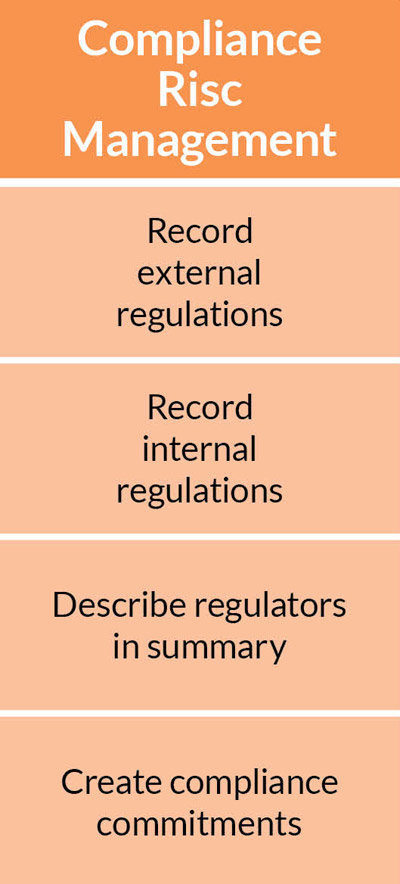
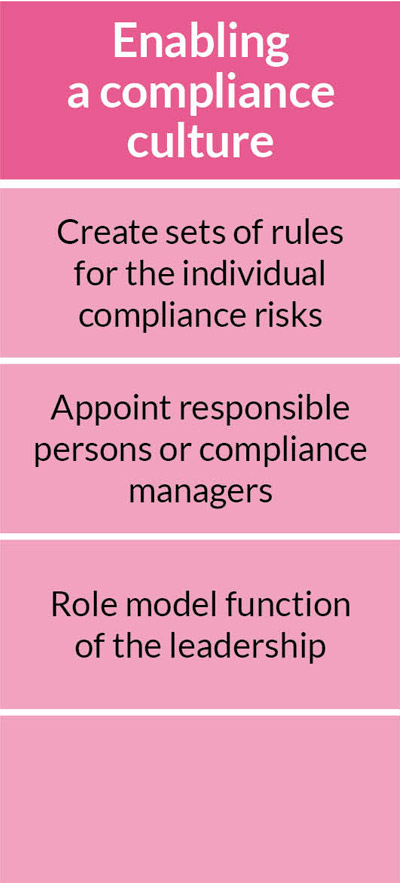
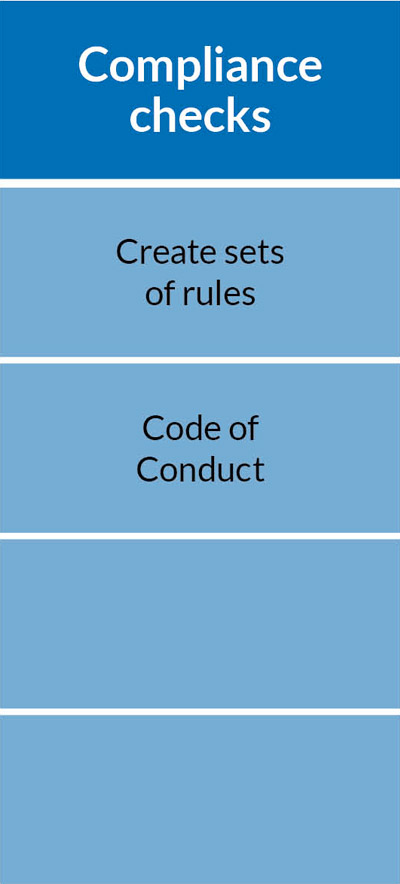

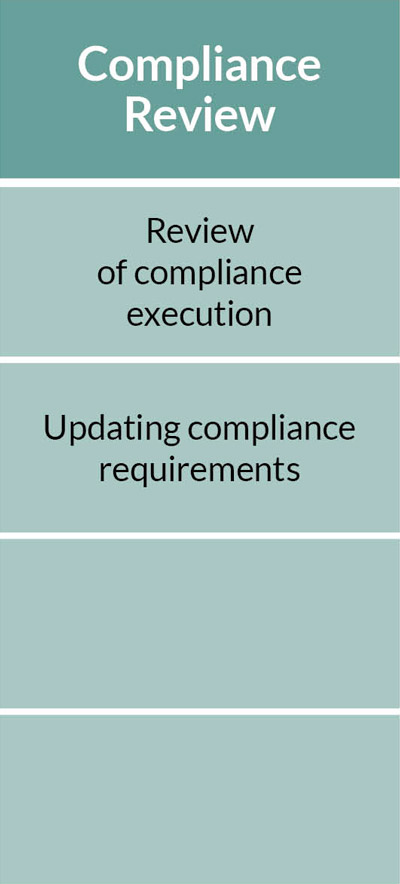
At LINNEMANN, we have recognized the requirements. Targets have been set and responsibility has not been handed over to a compliance officer to deal with, but every team member has been informed and trained. Everyone is actively involved.
By way of example and without priority, we describe below the topics that are listed in the Compliance Management System and that accompany us in our daily work. This continuity ensures awareness, compliance, review and improvement. In this way, breaches of the rules can be efficiently avoided.
We have stored tables, various details and summaries on each topic for you to download in standardized PDF/A format. For security reasons, we do not make open file formats such as Word or Excel available for download. If you require these formats, you can convert the content from the PDF file accordingly.
A
B
Bisphenol A (BPA, CAS-Nr. 80-05-7)
Linnemann GmbH hereby confirms that all products within its scope of delivery and services have been assessed with regard to Bisphenol A (BPA, CAS No. 80-05-7).
Based on the evaluations carried out, available supplier information and the currently applicable regulatory requirements, it is confirmed that the products comply with the provisions of the European Union. This includes in particular:
- the requirements of the REACH Regulation (EC) No 1907/2006, including the information obligations concerning Substances of Very High Concern (SVHC) pursuant to Article 33,
- the relevant restrictions under REACH Annex XVII, where applicable, and
- the requirements for materials and articles intended to come into contact with food pursuant to Regulation (EU) No 10/2011 as amended by Regulation (EU) 2024/3190.
Our stainless steel products typically do not contain Bisphenol A, as this substance is not used in metal processing production.
For products intended for food contact, it is ensured that Bisphenol A is not intentionally used in the manufacturing process and that the strict requirements of Regulation (EU) 2024/3190 (including the applicable detection limits) are met.
The assessment is based on the currently available information from the supply chain as well as on the currently valid legal requirements. LINNEMANN GmbH continuously monitors regulatory developments and will take appropriate measures if necessary to ensure ongoing compliance.
 » Download PDF
C
California Proposition 65 – Safe Drinking Water and Toxic Enforcement Act of 1986
California Proposition 65 is a state law designed to protect drinking water sources from contamination by chemicals known to cause cancer, birth defects, or other reproductive harm. Companies that sell products in California are required to inform the public about exposure to such chemicals.
California Proposition 65 is implemented through, among other things, a list of well over 1,000 chemicals suspected of being carcinogenic or toxic to reproduction. If one of these chemicals is contained in a product, the product must be labeled with an appropriate warning.
In this regard, LINNEMANN GmbH has conducted a voluntary inquiry about its supply chain and would like to inform its customers that the following substances of the current California Proposition 65 may be contained in our products:
Carbon Black, CAS: 133-86-4
- contained in blackened plastics and elastomers
- Firmly bound, not inhalable
Nickel (metallic), CAS: 7440-02-0
- Basically contained in almost all our metallic products
- Firmly bound in material
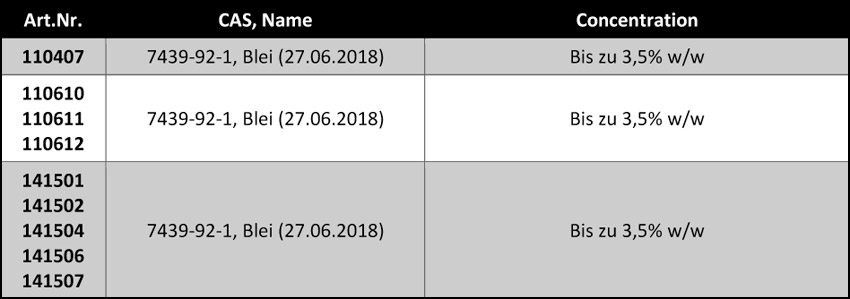
Lead and lead compounds, CAS 7439-92-1
- Below you will find a list of products with elevated lead levels
- Firmly bound in material
According to California Proposition 65 the exposure of a substance and not the concentration in the homogeneous material is decisive for the application of a warning notice. LINNEMANN GmbH does not supply directly to the US state of California, nor can the use of the products supplied by us be predicted or evaluated. Likewise, no analyses of exposure are carried out on the part of LINNEMANN.
Therefore, the products of LINNEMANN GmbH are not labeled with a warning according to California Proposition 65.
LINNEMANN GmbH would like to point out that further obligations may arise for customers of products due to their use.
LINNEMANN GmbH assumes no liability for products sold into the State of California if they are not properly labeled.
The current valid list and additional information can be found on the California Office of Environmental Health Hazard Assessment (OEHHA) website. https://oehha.ca.gov/proposition-65
CDA – Confidentiality agreement
Confidentiality agreements are not subject to legal regulation. LINNEMANN GmbH has formulated a description for business partners and customers on the observance of confidentiality, communicated it to the team and makes this internal description available for commitment in case of inquiries e.g. on a NDA - Non disclosure agreement. Care has been taken to ensure that the commitments to maintain confidentiality are tenable.
China RoHS II
LINNEMANN GmbH hereby confirms that all its products comply with the directive GB/T 26572-2011 also known as China RoHS II. LINNEMANN does not supply products directly to the People's Republic of China. Likewise, LINNEMANN GmbH confirms conformity according to Directive SJ/T 11363-2014 on mandatory labeling of toxic and hazardous substances in electronic products
Regulated substances and limits:
- Lead (Pb) 0.1 %
- Cadmium (Cd) 0.01 %
- Mercury (Hg) 0.1 %
- Hexavalent chromium (Cr+6) 0.1 %
- Polybrominated biphenyls (PBB) 0.1 %
- Polybrominated diphenyl ethers (PBDE) 0.1 %
LINNEMANN GmbH confirms that all products comply with China RoHS II with the exception of the products listed below:
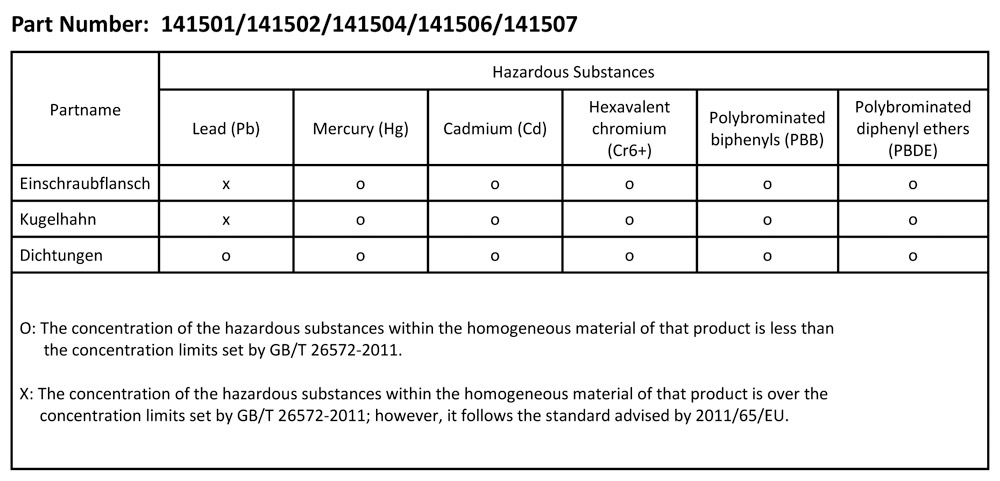
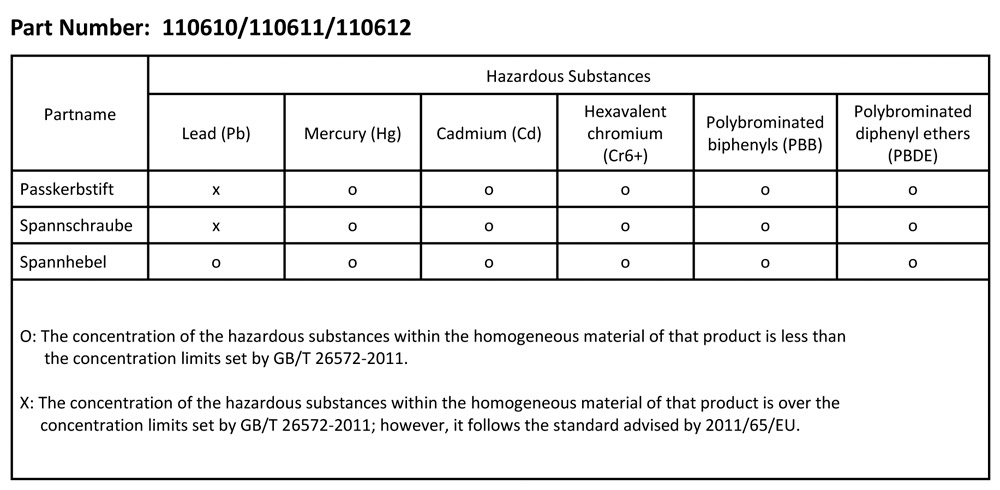
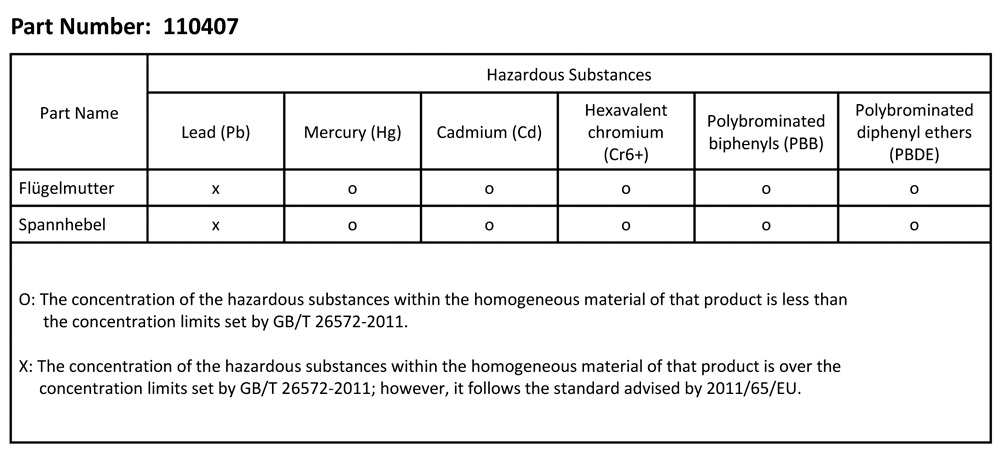
It should be noted that only electrical and electronic end products must be provided with the appropriate labeling. LINNEMANN Gmbh does not supply electrical and electronic products and therefore does not have to provide any labeling, but does provide its customers with the necessary information for final labeling.
Code of Conduct
The cross-sector Code of Conduct describes principles and standards of behavior relevant to the mechanical and plant engineering industry as well as the electrical and digital industries that responsible companies must observe in order to act responsibly.
A comprehensive description of the recommendations is provided by ZVEI (German Electrical and Digital Manufacturers' Association) and VDMA (German Engineering Federation) in the document. » Download PDF – ZVEI-VDMA-Code-of-Conduct-2022-01-en.pdf
LINNEMANN GmbH applies the Code of Conduct as described in this document.
Compliance Risk Management
Within the framework of the Compliance Risk Assessment, LINNEMANN carries out risk analyses as part of its risk management, identifies, assesses and communicates how any hazards can be countered.
Conflict Minerals – Section 1502 of the US Dodd-Frank Act.
The term "conflict minerals" under section 1502(e)(4) includes the four chemical elements tin, tantalum, tungsten, and gold, also called 3TGs, that originate in a particular part of the world where there is conflict affecting the mining and trade of these minerals.
LINNEMANN GmbH is aware of its social responsibility regarding environment, safety, health and human rights. Even though LINNEMANN GmbH is not subject to the reporting requirements of the Dodd-Frank Act, a survey of the entire supply chain is carried out once a year on a voluntary basis and a CMRT (Conflict Minerals Reporting Template) for the previous fiscal year is made available to our customers.
Current changes in the status of smelters cannot be considered, but will be reviewed and considered in subsequent CMRT reporting.
Via the following link you can download our currently valid CMRT version 6.4.
» Download PDF – LINNEMANN_RMI_CMRT_6.4_24.06.2024 EN.pdf
Smelter list
» Download PDF – LINNEMANN_RMI_CMRT_6.4_24.06.2024 Smelter list EN.pdf
Crisis management
Crises do not announce themselves. Crises can have internal and external causes. In order to be able to continue to proceed in a structured manner in the event of a crisis, LINNEMANN GmbH has defined indicators and procedures for various scenarios.
CSRD (Corporate Sustainability Reporting Directive)
The CSRD (Corporate Sustainability Reporting Directive) is an EU directive that requires companies to publish detailed reports on their sustainability practices. Starting in 2025, companies in certain size categories and with public interest must disclose comprehensive information on Environmental, Social, and Governance (ESG) aspects. The goal of the CSRD is to create more transparency and comparability regarding sustainable business practices, providing investors and other stakeholders with a solid decision-making basis.
LINNEMANN GmbH is not subject to the reporting obligations of the CSRD due to its size and legal form. However, consciously acting sustainably is a core principle of the company. For this reason, LINNEMANN GmbH regularly considers issues such as resources, environment, and society as part of its management reviews. These reviews are conducted within the framework of the certified quality management system according to DIN EN ISO 9001:2025. The self-set goals are continuously monitored, and, if necessary, actions are defined and implemented.
The goal of LINNEMANN GmbH is to use all the resources required for its operations – both natural and social in origin – in a way that does not limit the ability of future generations to act freely.
D
Data protection declaration
LINNEMANN GmbH takes the protection of personal data very seriously. We treat personal data - if collected at all - confidentially and in accordance with the statutory data protection regulations EU-DSGVO Regulation (EU) 2016/679.
Data Protection Officer: Appointed is Mr. Kretzschmar, of the company IT Services Dr. Krejci, Grüner Weg 60, 72766 Reutlingen, Germany.
List of processing activities: The processing activities are recorded as part of the process descriptions.
Data protection commitment of employees: The employees of LINNEMANN who handle personal data have signed the data protection commitment
Duty to provide information and disclosure: Linnemann employees, customers and partners will receive information about any stored personal data upon justified request.
Deletion of data: In accordance with the regulation, data will be deleted immediately after collection, after use or in accordance with the applicable retention regulations, depending on the purpose of use.
Security: All LINNEMANN data is protected against access by unauthorized persons.
Order processing: There is a contract for order data processing with the web hosting provider
Data protection violations: The address for reporting an incident online is known and the report can be made immediately.
DUAL-USE – Regulation (EU) 2021/821
Based on current information, no export license is required for dual-use goods described in the LINNEMANN catalog. The products are not listed in Annex I of Regulation (EU) 2021/821 (EU Dual-Use Regulation) nor in the Export List (Appendix AL to the Foreign Trade and Payments Ordinance—AWV).
Regardless of this classification, a licensing requirement may arise from the so-called catch-all clauses (Articles 4 and 4a of Regulation (EU) 2021/821 and Section 9 of the AWV), particularly in cases where a military or NBC-weapons-related end-use is known or has been declared.
The final determination of whether a license is required in each individual case is the responsibility of the exporter.
https://eur-lex.europa.eu/legal-content/DE/TXT/PDF/?uri=CELEX:32021R0821
E
EMRT - Extended Mineral Reporting Template
The Extended Minerals Reporting Template (EMRT) is a standard reporting tool developed by the Responsible Minerals Initiative (RMI). It is designed to support due diligence requirements for identifying and disclosing information about the supply chains of six minerals: cobalt, mica, lithium, nickel, copper, and natural graphite.
The template was introduced on October 20, 2021, and will be expanded in 2025 to include additional minerals in the reporting.
The use of the EMRT is currently voluntary and serves to promote transparency within the supply chain.
Via the following link you can download our currently valid EMRT version 2.1.
» Download PDF – LINNEMANN EMRT 2.1 – 25.03.2026 EN.pdf
Smelter list
» Download PDF – LINNEMANN EMRT 2.1 – 25.03.2026 Smelter list EN.pdf
EUDR – Declaration of due diligence (European Deforestation Regulation)
The EU Deforestation Regulation (EUDR, Regulation (EU) 2023/1115) aims to ensure that certain raw materials and products made from them do not contribute to deforestation or forest degradation.
Linnemann GmbH hereby confirms that, for the relevant raw materials and products falling within the scope of the EUDR, the necessary due diligence measures have been or are being carried out in accordance with the requirements of the Regulation.
Based on this due diligence assessment, it has been determined that there is no risk, or only a negligible risk, that the raw materials or products in question do not comply with the requirements of Article 3 of Regulation (EU) 2023/1115.
In particular, this means that the raw materials and products in question:
- are deforestation-free,
- have been produced in accordance with the relevant legislation of the country of origin, and
- are covered by a valid due diligence statement.
The declaration applies exclusively to the relevant raw materials and products covered by the Regulation, in particular cattle, cocoa, coffee, oil palm, rubber, soy, and timber, as well as products derived therefrom, as listed in Annex I of the Regulation.
Linnemann GmbH continuously monitors regulatory developments and ensures compliance with the applicable requirements of the EUDR within the European Union.
The Regulation is applied in accordance with the currently valid transition periods:
- as of December 30, 2026, for large and medium-sized enterprises,
- as of June 30, 2027, for micro and small enterprises (where applicable).
LINNEMANN GmbH
EUDR Representative
Martin Linnemann
Tübingen, 26.03.2026
F
G
H
I
J
K
KRITIS and NIS-2 Dachgesetz (CER law)
The NIS-2 Directive is an EU-wide regulation aimed at strengthening cybersecurity, replacing the previous NIS Directive. It requires companies and public institutions in critical sectors – such as energy, healthcare, transportation, digital services, and public administration – to implement comprehensive IT security measures.
The KRITIS Framework Act is a proposed German law aimed at enhancing the physical security and resilience of critical infrastructures. It transposes the European CER Directive (Critical Entities Resilience Directive) and complements existing cybersecurity regulations, such as the NIS-2 Directive. The law obligates operators in eleven critical sectors – including energy, healthcare, transportation, water, food, and administration – to implement specific measures, such as access controls, emergency plans, risk assessments, and reporting obligations.
LINNEMANN GmbH is not subject to the obligations of the KRITIS Framework Act or the NIS-2 Directive. However, the company proactively implements key measures from the NIS-2 Directive to protect itself against cyberattacks and other threats. In doing so, LINNEMANN GmbH addresses not only digital security aspects but also enhances physical security, for example, through biometric access controls and targeted cybersecurity measures to improve operational resilience.
L
M
Mission Statement
Cultural management at LINNEMANN GmbH is characterized by a self-image that includes various principles such as values, attitudes, responsibility and environmental awareness.
The company philosophy also includes practiced connectivity. The team develops its strength from the totality. Functioning communication channels are an important prerequisite here. Digitization, networking and communication platforms such as feedback and team meetings are available and used at LINNEMANN GmbH.
Read about self-image and values in the LINNEMANN GmbH Mission Statement.
N
NIS-2 and KRITIS Dachgesetz (CER law)
The NIS-2 Directive is an EU-wide regulation aimed at strengthening cybersecurity, replacing the previous NIS Directive. It requires companies and public institutions in critical sectors – such as energy, healthcare, transportation, digital services, and public administration – to implement comprehensive IT security measures.
The KRITIS Framework Act is a proposed German law aimed at enhancing the physical security and resilience of critical infrastructures. It transposes the European CER Directive (Critical Entities Resilience Directive) and complements existing cybersecurity regulations, such as the NIS-2 Directive. The law obligates operators in eleven critical sectors – including energy, healthcare, transportation, water, food, and administration – to implement specific measures, such as access controls, emergency plans, risk assessments, and reporting obligations.
LINNEMANN GmbH is not subject to the obligations of the KRITIS Framework Act or the NIS-2 Directive. However, the company proactively implements key measures from the NIS-2 Directive to protect itself against cyberattacks and other threats. In doing so, LINNEMANN GmbH addresses not only digital security aspects but also enhances physical security, for example, through biometric access controls and targeted cybersecurity measures to improve operational resilience.
Non-disclosure agreement
Secrecy and confidentiality / Business Secrets Act (GeschGehG)
For legal reasons, we generally do not complete questionnaires or queries via portals, as these often contain obligations that go beyond the legal requirements, which require extensive examination and cannot be easily ensured.
In accordance with the legal requirements derived from EU Directive 2016/943, the LINNEMANN GmbH team is fully informed about the objectives and instructed on how to deal with business secrets via a work instruction.
When processing transactions, we receive and record data of various kinds. All LINNEMANN employees are instructed in the handling of data and are obliged to use it carefully and confidentially and to store it securely. Data is only passed on to third parties if this is necessary for the specific process. LINNEMANN qualifies its data protection processes through the QA officer and coordinates them regularly, also with an external data protection officer.
All incoming and outgoing goods are carefully stored, packaged and dispatched by selected partners that we trust. This also applies to samples that we receive from customers or partners.
O
P
Packaging and Packaging Waste Regulation (PPWR) – Regulation (EU) 2025/40
Linnemann GmbH takes its responsibility for a sustainable circular economy very seriously.
The PPWR only affects the transport and protective packaging (e.g. cartons, protective films, pallets and strapping) that we use when placing our products on the EU market.
Our position and measures:
- We are already registered under the German Packaging Act (VerpackG) (registration number: DE4681766215792) and fulfil all obligations, including quantity reporting and the provision of take-back and recovery options for B2B packaging.
- The PPWR (Regulation (EU) 2025/40) entered into force on 11 February 2025 and will apply uniformly across the entire EU from 12 August 2026. It replaces the previous Packaging Directive 94/62/EC and sets higher requirements for recyclability, minimisation of packaging waste, design for recycling and labelling.
- We continuously optimise our packaging processes to fully meet the future requirements regarding recyclability, material minimisation and harmonised labelling.
As soon as the final implementing provisions and harmonised standards are published, further information will be available here.
For further information or specific enquiries regarding our packaging materials, please do not hesitate to contact us at any time.
PFAS – EU regulations on chemicals
Per- and polyfluoroalkyl substances (PFAS) are a large group of industrially produced chemicals that are used in numerous applications due to their water-, grease-, and dirt-repellent properties. These include coatings, plastics, and specialized industrial applications.
Within the European Union, various regulatory restrictions already exist for individual PFAS substances and groups of substances. In addition, in 2023, five European countries (Germany, the Netherlands, Denmark, Norway, and Sweden) submitted a comprehensive restriction proposal for PFAS under the REACH Regulation to the European Chemicals Agency (ECHA).
This proposal is currently undergoing the scientific evaluation process. The Committee for Risk Assessment (RAC) has already finalized its opinion, while the Committee for Socio-Economic Analysis (SEAC) adopted a draft of its opinion in March 2026.
A final decision on a possible further restriction of PFAS at the EU level is currently pending.
Further information on the current status of the procedure is available on the website of the European Chemicals Agency (ECHA): ECHA website.
Regardless of this, specific regulatory requirements and restrictions already apply to certain PFAS applications (e.g., specific substance groups or applications such as firefighting foams, for which a separate EU restriction has been in place since 2025).
The applicable legal requirements and restrictions in the European Union are being complied with.
POP – REGULATION (EU) 2019/1021
Persistent organic pollutants (POPs) are organic substances that can harm humans and the environment and whose degradation or transformation in the environment is very slow.
POPs are the subject of the Stockholm Convention on POPs and the POP Protocol under the United Nations Economic Commission for Europe (UNECE) Convention on Long-Range Transboundary Air Pollution (CLRTAP). Both conventions under international law have the overarching goal of reducing or eliminating the production, use and release of the substances as far as possible. The implementation in Europe took place through the "Regulation (EU) 2019/1021 on Persistent Organic Pollutants" (POP Regulation)" adopted on June 20, 2019. The regulation is directly applicable in all EU member states and does not require transposition into national law.
The controlled substances under the POPs Regulation are contained in Annexes I and II. Annex I lists the banned substances and Annex II lists the restricted substances. Article 3 of the POPs Regulation prohibits the production, placing on the market and use of all substances listed in Annex I.
LINNEMANN GmbH has checked its supply chain and can confirm that none of the substances listed under Regulation (EU) 2019/1021 are used in the products of LINNEMANN Gmbh.
This confirmation is based on the feedback of our suppliers, LINNEMANN GmbH does not perform own analyses and tests of its products regarding Regulation (EU) 2019/1021.
Q
R
REACh – Regulation (EC) 1907/2006
On June 1, 2007, Regulation (EC) No. 1907/2006 concerning the Registration, Evaluation, Authorization and Restriction of Chemicals (in short: "REACh") came into force. As a downstream user and distributor of articles, the company Linnemann GmbH is not obliged to register chemicals.
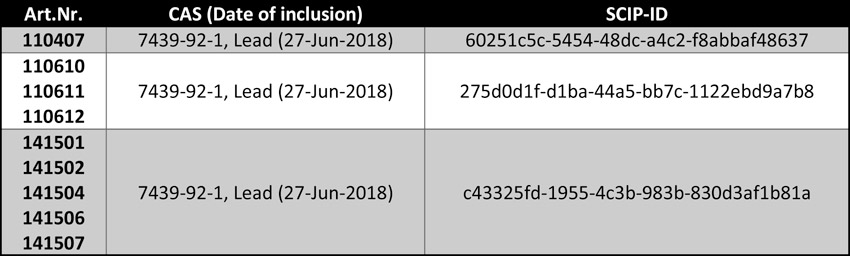
According to Art. 33 of the REACh regulation, the company Linnemann is subject to the obligation to pass on information about substances in articles, if one of the delivered products contains a substance of very high concern (SVHC) in a mass concentration above 0.1%.
The list of SVHC substances is maintained by the European Chemicals Agency (ECHA) and can be viewed at the following link https://echa.europa.eu/de/candidate-list-table.
LINNEMANN GmbH would like to inform its customers that, with the exceptions listed below, none of the products contains a SVHC with a mass concentration above 0.1%.
None of the products contains any of the substances subject to authorization listed in Annex XIV.
The prohibitions on the use of substances in accordance with Annex XVII are also observed and complied with.
Products with SVHC:
RoHS – EU Directive 2011/65/EU with amendment 2015/863/EU
The EU Directive 2011/65/EU on the restriction of the use of certain hazardous substances in electrical and electronic equipment, known as RoHS for short, was transposed into German law in 2013 by the ElektroStoffV and comprises 6 substances. In 2015, the list of regulated substances was extended by another 4 substances through the delegated directive 2015/863/EU.
Substances regulated in Annex II of the RoHS Directive with concentration limits in homogeneous materials in percent by weight:
| • Lead | 0,1% |
| • Mercury | 0,1% |
| • Cadmium | 0,01% |
| • Hexavalent chromium | 0,1% |
| • Polybrominated biphenyls (PBB) | 0,1% |
| • Polybrominated diphenyl ethers (PBDE) | 0,1% |
| • Butyl benzyl phthalate (BBP) | 0,1% |
| • Dibutyl phthalate (DBP) | 0,1% |
| • Diisobutyl phthalate (DIBP) | 0,1% |
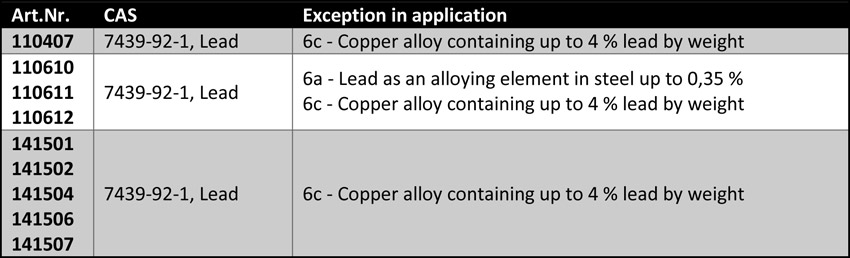
LINNEMANN GmbH confirms that all products comply with the requirements of the RoHS Directive. The following products use one or more exemptions according to Annex III:
S
Sanctions against Russia
Opinion on "COUNCIL REGULATION (EU) No 833/2014 of 31 July 2014 concerning restrictive measures in view of Russia's actions destabilizing the situation in Ukraine"
With the EU's 11th sanctions package, a verification requirement for iron and steel imports will
come into force on September 30, 2023.
The goods concerned are described in ANNEX XVII - List of iron and steel products in accordance with Article 3g. The list with the customs tariff number groups 72...... and 73...... can be found at Lexparency
https://lexparency.de/eu/32014R0833/ANX_XVII/
Specifically, this means that from September 30, 2023, proof of the country of origin of certain iron and steel goods (listed by Lexparency) that were used to process the product in a third country must be provided at the time of import.
LINNEMANN GmbH does not import any finished metal goods from Russia, nor does LINNEMANN GmbH process any primary products from Russia. LINNEMANN GmbH has requested all suppliers and pays attention to the corresponding evidence that the requirements of the 11th sanctions package are complied with. For its part, LINNEMANN GmbH takes into account that the evidence is listed when issuing certificates.
STRT 3.2
The Slavery and Trafficking Risk Template (STRT) is a free, open-source data collection template that forms the backbone of corporate modern slavery due diligence programs. It is maintained by a Development Committee committed to ensuring it keeps stride with new research and evolving industry needs. It is housed under the Social Responsibility Alliance, an initiative dedicated to providing companies with the open-source data collection tools they need to build socially responsible supply chains. Details can be read at https://www.socialresponsibilityalliance.org/resource/W-STRT-Overview-230217.pdf
LINNEMANN GmbH describes its procedure under the item Supply Chain Sourcing Obligation Act. Supply Chain Sourcing Obligations Law
Supply Chain Sourcing Obligations Law
The German Supply Chain Due Diligence Act (Lieferkettensorgfaltspflichtengesetz – LkSG) requires companies to comply with human rights and certain environmental due diligence obligations within their supply chains.
Linnemann GmbH implements the requirements of the LkSG in accordance with the applicable legal provisions. This includes in particular:
- the establishment of an appropriate risk management system,
- the performance of regular risk analyses,
- the implementation of preventive and remedial measures,
- the establishment of a complaints procedure, and
- compliance with the applicable documentation and reporting obligations.
The due diligence obligations apply to the company’s own business operations and direct suppliers. With regard to indirect suppliers, appropriate measures are taken if substantiated knowledge of potential human rights or environmental risks or violations is obtained.
Reports of potential risks or violations can be submitted via the established complaints procedure: beschwerde@linnemann-online.com
At the European level, the Directive (EU) 2024/1760 on corporate sustainability due diligence (CSDDD) has entered into force. This directive will further develop and harmonize existing national regulations.
EU Member States are required to transpose the CSDDD into national law by 26 July 2027. LINNEMANN GmbH continuously monitors regulatory developments and will adapt its processes accordingly to ensure timely compliance with future requirements.
Compliance with applicable legal requirements regarding human rights and environmental due diligence is ensured.
T
TSCA Section 6(h) – Toxic Substance Control Act Section 6(h)
On January 06, 2021, the USEPA (Unites States Environmental Protection Agency, or EPA) finalized Toxic Substance Control Act Section 6(h) rules to reduce exposure to five persistent, bioaccumulative, and toxic chemicals. These chemicals accumulate in the environment over time and therefore can pose potential risks to the public and consumers.
Listed below are the five PBT substances that are restricted or banned from manufacture, processing, and/or distribution in commerce in the United States:
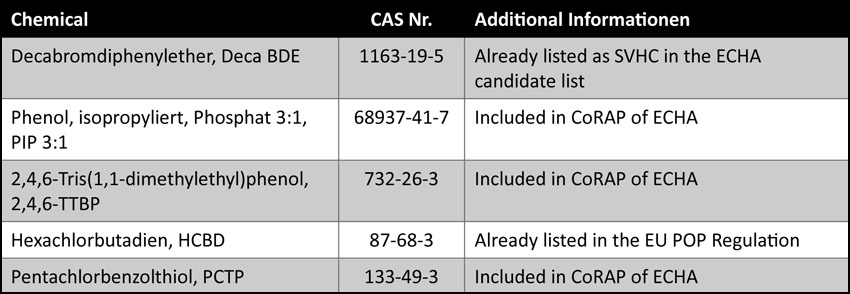
LINNEMANN GmbH has checked its supply chain for the five substances listed above and can confirm that none of these substances are present in LINNEMANN GmbH products.
This confirmation is based on feedback from suppliers, LINNEMANN GmbH does not perform its own analysis and testing of its products with respect to the Toxic Substance Control Act Section 6(h).